The sight of a Great Dane bounding toward you with unbridled enthusiasm can be enough to make even the most ardent dog lover take a step back. These gentle giants, often weighing over 150 pounds and standing taller than some humans when on their hind legs, possess a physicality that can be easily misread. What owners know to be playful exuberance often reads as aggression or intimidation to strangers—or even to other dogs. This phenomenon, which we might call "intimidation by anatomy," creates unique challenges for Great Dane owners and underscores how profoundly body language is shaped by scale.
Great Danes didn’t get the memo that they aren’t lapdogs. Their playful bows, enthusiastic pawing, and full-body wiggles are textbook canine invitations to play—when executed by a Labrador or a Beagle. But when a dog the size of a small horse engages in these behaviors, the context shifts dramatically. A play bow from a Great Dane doesn’t read as "Let’s have fun!" so much as "I might be preparing to launch myself at you." The sheer physics of their movement—the way their weight displaces air, the thunderous sound of their paws hitting the ground—adds a visceral layer that smaller dogs simply don’t convey.
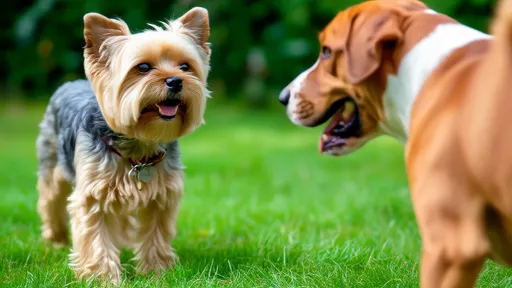
The problem isn’t just human perception. Other dogs frequently misread Great Danes’ body language too. Canine communication relies heavily on subtle cues—ear positioning, tail stiffness, the angle of approach. A Great Dane’s version of "subtle" might involve knocking over a coffee table with a tail wag. Smaller dogs, wired to read larger animals as potential threats, often react defensively to what was meant as friendly overtures. This creates a vicious cycle: the Great Dane’s confused reaction to the smaller dog’s defensive posture further escalates the situation. Many owners report their Danes being perceived as bullies at dog parks when in reality, they’re just hopelessly bad at scale-appropriate socializing.
This miscommunication has evolutionary roots. In the animal kingdom, size difference often signals predator-prey dynamics. A recent study published in Canine Cognition Journal found that dogs under 30 pounds showed significantly more stress behaviors when approached by unfamiliar large dogs compared to dogs their own size—regardless of the larger dog’s demonstrably friendly demeanor. The researchers noted that small dogs’ reactions mirrored those shown toward known aggressive breeds, suggesting an instinctive response rather than a learned one. For Great Danes, bred as boar hunters before becoming companion animals, this creates a cruel irony: their ancestors’ physical traits now work against their social success.
Owners of giant breeds develop a peculiar sixth sense for these moments—the subtle stiffening of a stranger’s posture, the quick intake of breath when their dog stands up. Some resort to preemptive verbal cues ("He’s friendly!"), colorful accessories (bright "Friendly Giant" bandanas), or rigorous training to moderate their dog’s enthusiasm. Yet even the most disciplined Great Dane can’t escape the tyranny of physics. When a dog that size decides to leap for joy, the ground shakes. When they bark in excitement, windows rattle. Their very existence in public spaces becomes an exercise in managing others’ perceptions.
Perhaps the most poignant aspect of this phenomenon is how it affects the dogs themselves. Great Danes are famously sensitive, often described as "heartbreak dogs" not just for their short lifespans but for their emotional vulnerability. Repeated experiences of other dogs or humans recoiling from them can lead to genuine social anxiety. Trainers report that many Great Danes go through a phase of hesitant, almost apologetic body language—as if trying to make themselves smaller—before growing into their confidence. The ones who don’t may develop either excessive timidity or, in some cases, actual aggression born from frustration at constant misreading of their intentions.
The solution lies in education as much as training. Public awareness about canine body language—particularly how it scales across breeds—could prevent countless misunderstandings. Dog parks might benefit from separate areas for size-based play groups, not just for safety but to facilitate better communication. For their part, Great Dane owners must become fluent in translating their dog’s behavior for the world: that a looming head isn’t a threat but an invitation for ear scratches, that the paw the size of a saucer is extended in friendship, not challenge. In learning this unique dialect of dog, we might just become better at understanding communication across all species divides.
At the end of the day, the Great Dane’s plight reminds us that communication is never just about intent—it’s about how that intent is received. These magnificent dogs, with their cartoonish proportions and hearts to match, navigate a world not quite built for their brand of affection. Their struggles highlight how deeply size shapes perception, and how love, no matter how genuine, still needs the right vocabulary to be understood.
By /Jun 12, 2025
By /Jun 12, 2025
By /Jun 12, 2025
By /Jun 12, 2025
By /Jun 12, 2025
By /Jun 12, 2025
By /Jun 12, 2025
By /Jun 12, 2025
By /Jun 12, 2025

By /Jun 12, 2025
By /Jun 12, 2025
By /Jun 12, 2025
By /Jun 12, 2025
By /Jun 12, 2025
By /Jun 12, 2025

By /Jun 12, 2025

By /Jun 12, 2025
By /Jun 12, 2025
By /Jun 12, 2025