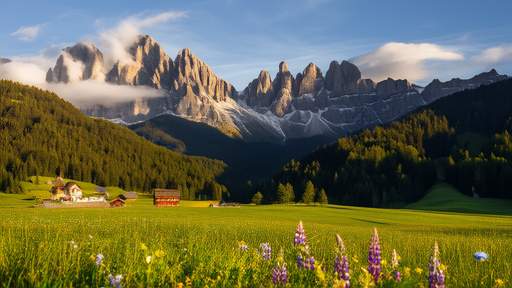
The Dolomites, with their jagged pinnacles, saw-toothed peaks, and bare rock walls, offer some of the most dramatic scenery in alpine Europe. A UNESCO World Heritage Site, these limestone formations were once coral reefs, transformed into mountains when the African and European tectonic plates collided 250 million years ago. The result is a stunning patchwork of vertical rock and rolling meadows dotted with alpine lakes, medieval castles, and charming mountain villages.
This striking natural setting makes the Dolomites a veritable outdoor playground, offering a wealth of open-air activities year-round. In winter, visitors can enjoy sledding, ice-skating, and skiing, while summer brings opportunities for hiking, cycling, and climbing. Cable cars whisk visitors up to the start of well-marked trails, many designed to be hiked in a few hours, while others cover a wide terrain with hikers refueling and bedding down in rifugi (simple mountain huts).
The Dolomites also offer a vibrant cultural scene, with excellent contemporary art galleries and museums. The culinary scene is equally worth exploring, featuring hearty cuisine made from local ingredients such as alpine cheeses and wild game. Vines have long been cultivated along the mountainous slopes, and there’s no shortage of vineyards, particularly along the Strada del Vino wine route, which snakes its way through the region.
The Dolomites mostly lie within Italy’s northernmost region of Trentino-Alto Adige, formed by two separate entities with distinct identities: the Italian-speaking Trentino to the south and Alto Adige, best known as SüdTirol (South Tyrol), where German is the preferred language. To the east, the Dolomites stretch into Veneto, home to Cortina d’Ampezzo, the host resort for the Milano Cortina Winter Olympics 2026, and as far east as Friuli-Venezia Giulia.
Day 1: Rovereto & Pinzolo
Head for the Hills
Catch a morning flight to Verona Airport and drive north to Trentino along the toll-road that runs to the east of Lake Garda. If time allows, trace the lakefront road instead, taking in scenic views along the way. Your first stop is Rovereto, where you can stretch your legs halfway to your final destination as you explore the excellent Mart, one of Italy’s premier contemporary and modern art museums. The collection includes over 20,000 works, with a focus on Italian art by the likes of Francesco Hayez, Carlo Carrà, and Giorgio de Chirico.
For lunch, grab a bite at the museum’s bistro, then proceed north to the Brenta Dolomites, arriving in Pinzolo. Visit the town’s Chiesa di San Vigilio to admire its 16th-century frescoes depicting the Dance of Death, then check-in at the family-run Bio Hotel Hermitage in Madonna di Campiglio, or splurge on a pampering stay at Lefay Resort & Spa Dolomiti in Pinzolo. For dinner, try Rendenèr, a contemporary-styled restaurant run by a young and dynamic team, serving flavorful dishes that make the most of valley ingredients.
Day 2: Val Nambrone
Alpine Lakes and Stunning Sunsets
Wake up early for your first trek, one of the most picturesque circular hikes in the area that takes you past a string of glorious alpine lakes (five hours total). Drive to the Val Nambrone, leaving your car at the Malga Vallina d’Amola car park, and hike to Rifugio Segantini in about an hour and a half. Stop off for a refreshing drink or a bite for lunch, before continuing to the 33-metre-deep Lago Nero. Try to reach the lake as the sun begins to set—it’s a stunning sight as the steep rocky walls and well-defined contours of the entire Brenta Dolomites range spread out before you.
From here, the route leads to the nearby Cornisello Lakes, where you can admire the peaks of the Adamello-Presanella range, before completing your loop. If you’re keen to experience a night in a rifugio, try Rifugio Cornisello, which offers half-board; alternatively, drive back to your hotel. Enjoy an aperitivo with a view courtesy of Sunsets at High Altitude, which sees participants enjoy a pre-dinner drink accompanied by live music at designated mountain venues.
Day 3: Adamello Brenta Nature Park
Protected Landscapes and Picnics
Today, you’ll trek to the heart of the Adamello Brenta Nature Park, Trentino’s largest protected area, home to over 1,300 species of plants, with chamois, deer, ibex, and foxes a common sight; brown bears have also been reintroduced. With over 700km of trails, there’s plenty to explore, including the Bosco Val Brenta, thick woods of towering larch and spruce trees.
Set off from Prà de la Casa, an agriturismo run by Matteo and Doriana who rustle up homemade fare using mountain herbs, and make for the Malga Brenta Bassa and Malga Brenta Alta, two ample clearings where you can sit back and unwind with a picnic lunch. You can take part in educational foraging trips through the woods with acclaimed forager Eleonora “Noris” Cunaccia or, if you’re up for something a little more unconventional, the Val Brenta is also home to eight natural wellness paths, including yoga, bare footing, tree hugging, and natural Kneipp paths, with itineraries that can be carried out independently or led by experts.
Come evening, treat yourself to a Michelin-starred dinner at the excellent Stube Hermitage at the hotel in Madonna, with a cozy wood-clad dining area set out to resemble a traditional alpine stube.
Day 4: Trento & San Martino di Castrozza
A Medieval Capital
First, drive east to the picture-postcard Lago Toblino, with its 16th-century namesake fortress and castle jutting out into the lake on a rocky spur. Take a gentle stroll along the lakefront promenade and grab a mid-morning coffee at Castel Toblino’s café, then continue your drive east to the delightful regional capital of Trento.
Spare some time to visit the Castello del Buonconsiglio, which affords lovely views of the medieval center. History buffs won’t want to miss the ruins of the ancient Roman city of Tridentum that lies below the historic center, and which now forms part of the SASS Underground Archaeological Space. If you’re traveling with children, make sure you visit Muse, Trento’s Science Museum, which sheds light on alpine ecosystems and the geology of the Dolomites mountains.
Enjoy a late lunch at Osteria Il Cappello or try Il Libertino, then continue your drive east to San Martino di Castrozza in the Parco Naturale Paneveggio, the jumping-off point for treks in the Pale di San Martino, the Dolomites’ largest massif. Overnight at the family-run Chalet Prà delle Nasse, enjoying supper at Ristorante Da Anita.
Day 5: Pale di San Martino
Via Ferratas and Rifugios
The Dolomites’ largest massif, the Pale di San Martino, is prime hiking territory, offering the most dramatic scenery of the Parco Naturale Paneveggio. From San Martino di Castrozza, a cable car whisks passengers up to Colverde, from where the Rosetta funicular cradles you up the mountainside to reach Rifugio Rosetta, the starting point for several trails of varying difficulty, some equipped with via ferratas.
A particularly favorite is the 7.5km Riviera di Manna that winds along the plateau in under three hours, which served as inspiration for acclaimed Italian novelist Dino Buzzati’s *The Tartar Steppe*. Experienced hikers could try the Anello dell’Altopiano, a loop that passes Rifugio Pradidali and crosses two mountain passes in just under five hours. For dinner, head to Malga Ces, a traditional mountain restaurant about a five-minute drive from San Martino di Castrozza.
Days 6, 7 & 8: Bolzano
Wine Routes and Michelin Stars
After breakfast, travel northwest to Bolzano, the provincial capital of German-speaking South Tyrol. As you cross into South Tyrol from Trentino, you’ll notice road signs in both Italian and German, and you’ll immediately sense the region’s distinctive central European culture.
As you approach Bolzano, join the Strada del Vino wine route, passing through exquisite vineyard landscapes where you can combine sightseeing with wine tasting. To the south of Bolzano, San Michele d’Appiano has a handful of great restaurants, including two Michelin-starred establishments, while perching above the town is Castel d’Appiano (Burg Hocheppan), worth visiting for its beautifully preserved secular frescoes and views of the surrounding area. Drive to Bolzano in the late afternoon and check in at Parkhotel Mondschein or try Hotel Greif; if you’d rather stay outside the city, the boutique Berghoferin offers a peaceful location. Savour elegant alpine dishes and Italian classics at Löwengrube, whose 13th-century wine cellar houses over 1,000 wines.
City Culture and the Iceman
Spend the day exploring Bolzano, one of the Dolomites’ most beautiful cities. Start at Piazza Walther, the central square lined with pastel and butterscotch palazzi, and stroll along the narrow Via dei Portici. The city’s prized attraction is the Museo Archeologico, housing the mummified body of Ötzi the Iceman, who was discovered in 1991 a few kilometers from the Austrian border.
For lunch, tuck into local specialties at Vögele, a historic restaurant serving traditional dishes in partitioned wood-clad dining areas. Around mid-afternoon, catch the Funivia del Renon (Renon cable car) from Piazza Walther to Soprabolzano, which offers fabulous views of the city and the jagged, saw-toothed peaks of the Catinaccio massif. A narrow-gauge railway connects Soprabolzano to Collalbo, from where you can follow trail 24 to reach a viewing platform. Come late afternoon, soak up sunset views with a drink at Gloriette Guesthouse or Parkhotel Holzner, where you can also enjoy dinner before catching the funicular back to Bolzano.
Mountaineering Legends and Beer Halls
Bolzano serves as the perfect base for several day trips, with plenty of sights within striking distance of the center. Renowned mountaineer and explorer Reinhold Messner hailed from Villnöss northeast of Bolzano, setting up a network of six museums in the region that shed light on alpine landscapes, the history of mountaineering, and mountain peoples. The Messner Mountain Museum at Castel Firmiano is the closest to the city; it has a striking setting, with a network of walkways and stairways taking you past displays and installations in one of the region’s oldest castles. The views of the Gruppo di Tessa mountains are a delight too.
Return for your last night in the city – try Batzen Häusl, one of the city’s historic beer houses that also serves Tyrolean specialties; if wine is more your thing, head to Lisa Wineboutique.
Day 9: Seiser Alm
The Largest Alpine Plateau in Europe
Drive east to the Seiser Alm grasslands, the largest alpine plateau in Europe, where verdant summer pastures and meadows offer gentle trekking through scenic landscapes. Treat yourself to the stylish Adler Lodge, which offers warm and cocooning rooms along with an excellent spa. There are scores of hiking paths in the area, and there’s no shortage of biking routes to suit all levels.
Following your hike or bike ride, unwind with a hay bath, an age-old tradition from the nearby village of Fiè allo Sciliar that sees participants lie in a tub wrapped in freshly cut hay enhanced with aromatic herbs such as thyme, gentian, and mountain arnica.
Adrenaline Kicks
Spend your last day in the fresh mountain air on a scenic outdoor activity, whether climbing or golfing in the nearby Seis am Schlern at the foot of the Seiser Alm – you can also explore this high alpine pasture from the comfort of a horse-drawn carriage. If you’re looking to end your stay on a high, try a tandem paragliding flight, or swoosh through meadows and woods on the Monte Pana Zipline in neighboring Val Gardena.
Enjoy a traditional lunch in verdant surrounds at one of the area’s mountain restaurants such as Heualm or Malga Schgaguler Schwaige, before driving to Bolzano Airport or Innsbruck Airport for your return flight home.
When to Go
Outside of the winter season, the best time to visit is between June and September; if you can, avoid the month of August when Italians take the bulk of their holidays – even the remotest of mountain paths can get congested. Note that many hotels and cable cars close after the winter season for a month or so, reopening in June.
What to Book
On a Budget
Inntravel offers a one-week “A Stroll in the Italian Dolomites” package from £1,160 per person, including seven nights’ half-board accommodation, luggage transfers, local travel, and route notes and maps. Flights not included.
A ‘Bootique’ Experience
Original Travel offers “Bootiquing in the Dolomites” from £3,150 to £5,200 per person, including four nights’ half-board accommodation, five days’ guided walking, luggage transfers, return flights, and airport transfers.
The Luxury Option
Cartology Travel offers bespoke trips in the Dolomites from £7,000 per person, including nine nights’ half-board accommodation, private transfers between resorts, six days with a private guide, activities, and selected experiences at each hotel. Flights not included.
Expert Tips
Getting Around
Renting a car is the best way to get around, allowing you to explore at your own pace, winding along scenic mountain roads and stopping off at sights along the way. There are good train links between Trento and Bolzano – Trentino and South Tyrol’s main cities – and several services run through South Tyrol’s main valleys. Otherwise, rail transport is limited, with buses mostly connecting mountain villages.
Clothing
Make sure you pack appropriate clothing and outdoor gear, including comfortable walking shoes, sunscreen, and a hat. Even in high summer, it can get chilly when hiking at high altitude – you should be prepared for wind, rain, and even snow.
Climbing Routes
Dotted throughout the Dolomites are via ferratas; climbing routes with ladders, rungs, and steel cables. Some are designed for novices and even young children, although note that most are for experienced climbers.
Place Names
Note that some locations have two – and sometimes three – names. In South Tyrol, you’ll find towns with both German and Italian names. Bolzano, for example, is known by its German name Bozen, while the Alpe di Siusi is Seiser Alm. Some towns also have names in Ladin, a Rhaeto-Romance language spoken by some 30,000 people around the Sella massif.
Air Travel
Several airports are conveniently placed, although flying to the wrong airport can result in lengthy transfers along winding mountain roads. Verona Airport is within easy reach of southern Trentino; Milan Linate and Milan Bergamo are good choices to explore the south and the west of the region; Venice is best for exploring the eastern Dolomites; while Bolzano Airport and Innsbruck are most convenient for South Tyrol.
Free Travel Opportunities
The Trentino Guest Card or a Südtirol Guest Pass (note these only work in their respective areas) give users free bus and train travel along with free or reduced rates for activities and sights. Find out more at visittrentino.info and suedtirol.info.
The Dolomites offer a unique blend of natural beauty, cultural richness, and outdoor adventure. Whether you’re a seasoned hiker, a wine enthusiast, or a history buff, this region has something to offer everyone. From the dramatic peaks of the Pale di San Martino to the charming streets of Bolzano, every corner of the Dolomites tells a story. This 10-day itinerary is designed to give you a taste of the region’s highlights, but the Dolomites are vast and varied, inviting you to return again and again to uncover their many secrets.
By William Miller/Jun 4, 2025
By Christopher Harris/Jun 4, 2025
By Samuel Cooper/Jun 4, 2025
By Sophia Lewis/Jun 4, 2025

By Eric Ward/Jun 4, 2025
By Amanda Phillips/Jun 4, 2025
By Samuel Cooper/Jun 4, 2025
By Natalie Campbell/Jun 4, 2025
By Samuel Cooper/Jun 4, 2025
By Grace Cox/Jun 4, 2025
By David Anderson/Jun 4, 2025
By Jessica Lee/Jun 4, 2025
By Emma Thompson/Jun 4, 2025
By Grace Cox/Jun 4, 2025