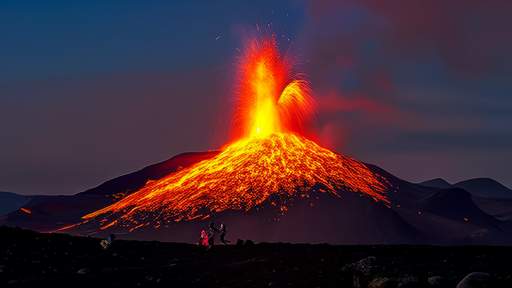
On a seemingly ordinary Monday, the tranquility of Sicily was shattered by the earth-shaking fury of Mount Etna, one of the world’s most active and awe-inspiring volcanoes. A massive eruption sent tourists scrambling down the slopes in a hurried retreat, as a towering plume of scorching gases, ash, and rock billowed several kilometers into the sky. The eruption, which began overnight, produced explosions so powerful that they were heard as far away as Taormina and Catania, cities located approximately 50 and 40 kilometers (31 and 25 miles) from the volcano, respectively.
Footage shared on social media captured the dramatic scene, with long lines of people hurrying downhill, their faces a mixture of awe and urgency. Giuseppe Panfallo, a guide with the tour company Go Etna, filmed his group huddled together, an enormous ash cloud looming ominously in the background. "We were nearly grazed, look at this cloud here," he narrated in the video. "We were two steps away, and thank goodness we have a responsible guide with us. It arrived all at once, an immense smoke, immense, immense roar."
Mount Etna, located on the Italian island of Sicily, is a popular tourist destination, attracting 1.5 million visitors each year. Many of these tourists trek almost all the way to its summit, drawn by the allure of standing at the edge of one of nature’s most powerful forces. Despite its reputation as one of the world’s most active volcanoes, eruptions of this magnitude have been relatively rare in recent years. The last significant eruption occurred in 2014, according to the National Institute of Geophysics and Volcanology Observatory.
The eruption, which began with a series of powerful explosions, quickly captured the attention of locals and tourists alike. One eyewitness, hiking guide Alessio Zocco, described the event as a "sudden, powerful boom." "Today’s eruption seemed, at first, similar to others — but what made it stand out was a sudden, powerful boom," he said. "It was a dramatic moment, but fortunately short-lived. Mount Etna is a majestic and unpredictable force of nature. It commands respect, but it also offers one of the most powerful and awe-inspiring experiences you can witness."
The observatory reported that preliminary observations indicated a "partial collapse" of the northern flank of the volcano’s southeast crater. This collapse produced spectacular lava flows, a phenomenon that has been witnessed in recent eruptions over the past few months. Despite the dramatic display, the observatory emphasized that there was "no danger for the population" at the time of the eruption. However, authorities remained vigilant, with the president of the Sicilian Region, Renato Schifani, urging "maximum precaution for hikers" and advising them to "avoid the summit area of the volcano until further notice, in consideration of the potential evolution of the phenomenon."
The eruption’s impact was felt beyond the immediate vicinity of the volcano. Ash clouds dispersed sporadically near the summit, while tremors gradually subsided to low values. The observatory noted that all three lava flows had begun to cool by late evening. Authorities were prepared to alert residents of Catania, the city at the foot of the volcano, to take cover if the wind shifted and brought ash their way. However, the city’s mayor, Enrico Tarantino, reported that none of the ash was expected to fall on Catania, and nearby airports in Catania and Palermo remained open, as the wind was not blowing the ash in their direction.
The Sicilian Civil Protection Agency instructed all flight traffic to avoid the area, and some flights from Catania were redirected to Palermo. Authorities also closed many of the roads leading up to the volcano to prevent curious onlookers from getting too close and interfering with emergency operations. Around 1 p.m. local time, the volcano began spewing hot lava, a more typical manifestation of its volcanic activity.
The eruption, though sudden and powerful, was not entirely unexpected. The National Institute of Geophysics and Volcanology Observatory had been monitoring increased seismic activity in the days leading up to the event. Despite the unpredictability of volcanic eruptions, the observatory’s early warning systems and the swift response of emergency crews ensured that all tourists and trekkers were safely evacuated. The immediate activation of monitoring and safety protocols was praised by local officials, who credited these measures with preventing any casualties.
As the eruption subsided, the volcano’s summit was left with a dramatic landscape of cooling lava flows and scattered ash. The event served as a stark reminder of the power and unpredictability of nature, even in a region as well-versed in volcanic activity as Sicily. For the tourists who witnessed the eruption, it was a once-in-a-lifetime experience, albeit one that required a hasty retreat.
Mount Etna’s eruptions, though infrequent, are a testament to the dynamic forces at work beneath the Earth’s surface. Each eruption offers scientists valuable insights into volcanic behavior, while also reminding visitors of the need for respect and caution when exploring such powerful natural environments. The volcano’s activity is a double-edged sword: it poses risks, but it also offers unparalleled opportunities for scientific research and awe-inspiring natural spectacles.
As the dust settled and the lava cooled, life on Sicily gradually returned to normal. Emergency crews stood down, and the roads leading to the volcano were reopened. Tour operators resumed their activities, albeit with heightened awareness of the volcano’s potential for sudden eruptions. The event underscored the importance of preparedness and respect for nature’s forces, especially in regions where such forces are a part of daily life.
Mount Etna’s eruption was a dramatic display of nature’s power, but it was also a testament to the resilience and preparedness of the local community. Through careful monitoring, swift action, and adherence to safety protocols, the region managed to navigate the eruption without significant incident. For the tourists who fled the volcano’s slopes, the experience was a humbling reminder of the forces that shape our planet. For the scientists who study the volcano, it was another chapter in the ongoing story of Mount Etna’s dynamic and ever-changing landscape.
By William Miller/Jun 4, 2025
By Christopher Harris/Jun 4, 2025
By Samuel Cooper/Jun 4, 2025
By Sophia Lewis/Jun 4, 2025

By Eric Ward/Jun 4, 2025
By Amanda Phillips/Jun 4, 2025
By Samuel Cooper/Jun 4, 2025

By Natalie Campbell/Jun 4, 2025
By Samuel Cooper/Jun 4, 2025
By Grace Cox/Jun 4, 2025

By David Anderson/Jun 4, 2025
By Jessica Lee/Jun 4, 2025

By Emma Thompson/Jun 4, 2025
By Grace Cox/Jun 4, 2025